How do airplanes stay up in the sky?
A jet can weigh as much as 80 elephants, and it floats through the air for hours. The secret is in the shape and tilt of the wings.
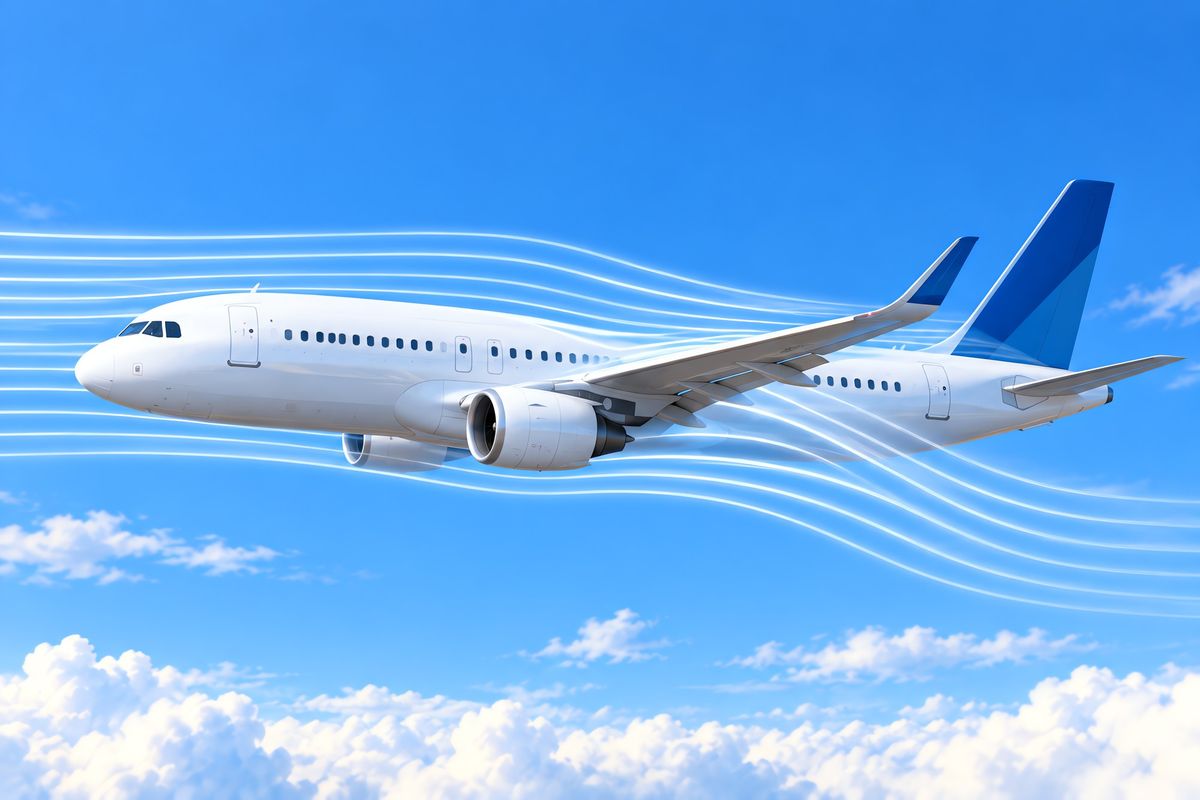
Hold your hand flat out of a car window (with a grown-up driving, and only if it is safe). Tilt the front edge up a little and your hand rises. Tilt it down and your hand dives. Your hand is a wing, and you have just felt lift.
An airplane wing is slightly curved on top and tilted so its front edge sits a little higher than its back edge. When air rushes past, the wing turns that air and sends it downward. Newton’s third law says that for every push there is an equal push back, so the air pushes the wing up.
How it works, in 3 steps
1. Engines push the plane forward fast. Jet engines or propellers do one main job: thrust. They move the plane forward so that air flows quickly over the wings. On a big airliner that means racing down the runway at around 150 to 180 miles per hour before the wings can do their job.
2. The tilted wing bends air downward. Air flowing over the top of the wing follows its curve and leaves the back edge heading down. Air hitting the tilted underside is pushed down too. The same flow makes the air pressure lower above the wing than below it.
3. Air pushes back, lifting the wing up. All that air being shoved downward pushes the wing upward in return. When lift is bigger than the plane’s weight, the plane climbs. When they are equal, it cruises level.
Speed matters a lot. Double a plane’s speed and the same wing makes four times as much lift. That is why planes need long runways to speed up before takeoff, and why they slow down and extend flaps (which make the wing bigger and more curved) to land gently.
Myth or fact?
“The engines are what hold a plane up.” Myth. Engines push the plane forward. The wings make the lift. That is why gliders, which have no engine at all, can fly for hours.
“Air over a wing meets air underneath at the back.” Myth. This is a popular textbook explanation, and NASA says it is wrong. Air over the top actually reaches the back edge first. The real reason is the wing turning air downward.
“Planes can’t fly upside down.” Myth. Stunt planes do it all the time. The pilot tilts the nose so that the wing, even upside down, still pushes air downward.
- Cut a strip of paper about 2 inches wide and 8 inches long. Hold one short end just under your bottom lip so the strip droops down in front of you.
- Blow steadily across the top of the strip, not underneath it.
- Watch the strip rise toward the air stream. Blow harder and it rises more.
Fast-moving air over the curved top of the strip has lower pressure than the still air underneath, and the strip is pushed up, just like a wing. Two minutes, one piece of paper, and you have made lift.
Sources
Every fact in this article was checked against these sources, which are also listed at the back of the book:
NASA Glenn Research Center: Incorrect lift theory #1
NASA Beginner’s Guide to Aeronautics: Velocity effects on lift
100,000 Whys for Curious Kids
This question is one of 100 in 100,000 Whys for Curious Kids by Daniel Why. Full-color illustrated encyclopedia, ages 6–13, every answer checked against real sources. A labeled diagram, three steps and three myths busted for every big question. Launching on Amazon in October 2026.
See it on AmazonFree Myth or Fact printable packMore big questions: see all the questions kids ask. Have a little one at home? The toddler and preschool edition is coming this fall.