How do fireflies light up?
With a tiny chemistry lab in their tails. And the light they make is almost completely cool.
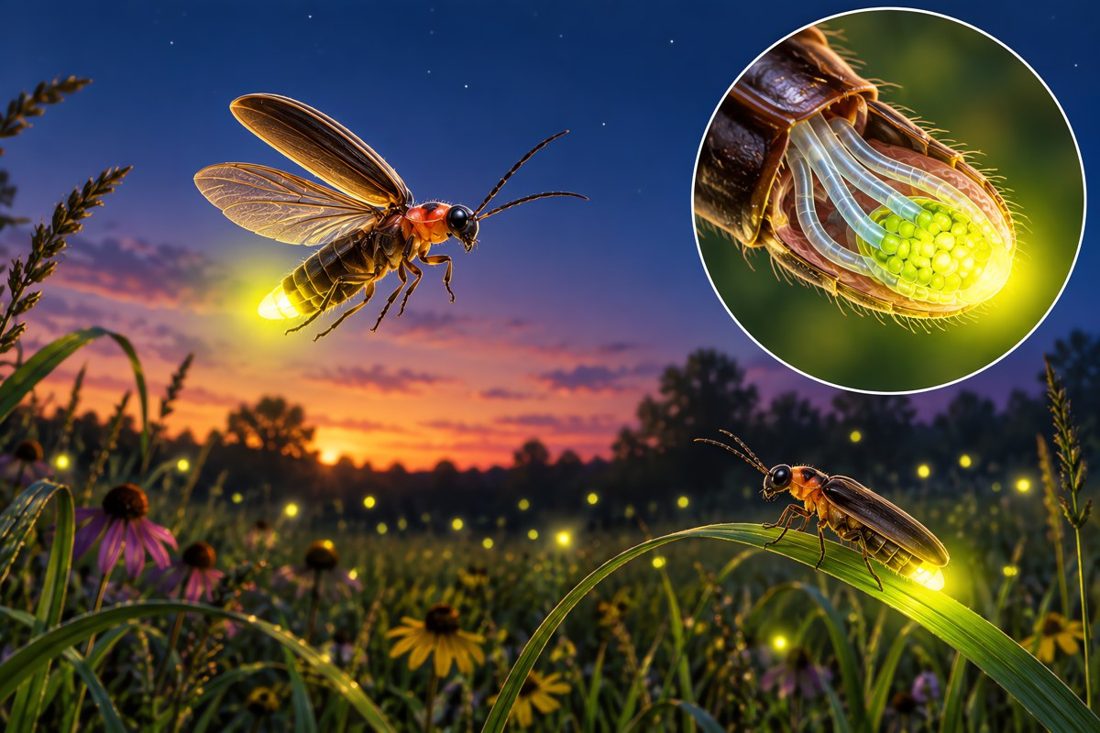
How it works, in 3 steps
1. Tiny air tubes let oxygen flow into the light organ at the tip of the belly.
2. Inside, luciferase helps luciferin react with the oxygen.
3. The energy comes out as a cool glow. By controlling the oxygen, the firefly can switch its light on and off.
Why do they flash?
To find each other. Each species has its own flash pattern, like a secret code. Males flash while flying, and females answer from the grass with their own species’ code.
Myth or fact?
“Fireflies are a kind of fly.” Myth. Fireflies are beetles, in a family called Lampyridae.
“A firefly’s light is hot like a light bulb.” Myth. It gives off almost no heat.
“All fireflies flash the same way.” Myth. Every species has its own pattern.
Spooky quick fact: some female fireflies copy another species’ flash code to lure its males in, then eat them.
Try it on a summer evening: watch one firefly and count the seconds between flashes. Then find another one and compare. Are they the same kind?
100 big questions like this one
This question comes from 100,000 Whys for Curious Kids by Daniel Why: a full-color visual encyclopedia for ages 6 to 12, with a labeled diagram for every big question, 100 Quick Whys and 300 myths busted. Out October 13, 2026.
Join the launch teamFree Myth or Fact cardsSources: Smithsonian Magazine and Smithsonian Environmental Research Center on firefly bioluminescence; Britannica, “Firefly”; Lewis S. M. & Cratsley C. K. (2008), Annual Review of Entomology, “Flash signal evolution, mate choice, and predation in fireflies”.