Why are flamingos pink?
Because of what they eat. A flamingo’s famous pink comes from its food, not from its genes.
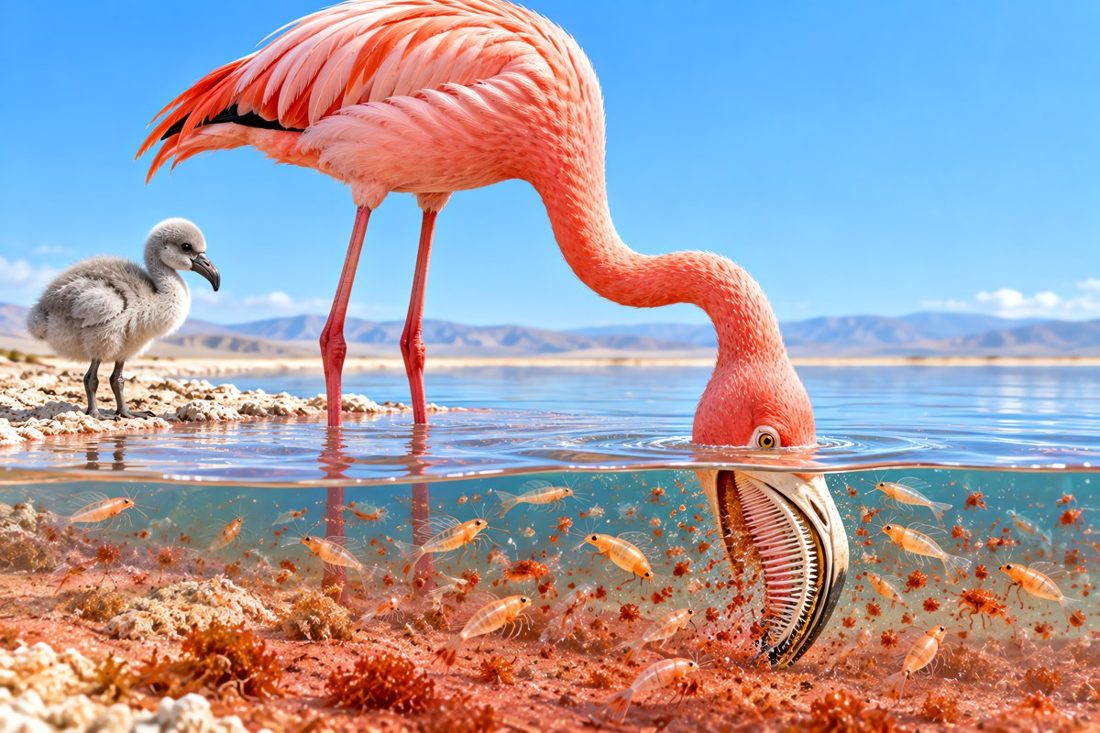
How it works, in 3 steps
1. Algae and tiny shrimp in salty lakes are packed with red-orange pigments, the same family of pigments that makes carrots orange.
2. A flamingo feeds with its head upside down, straining food out of the water with comb-like plates in its bill.
3. The pigments travel into the new feathers as they grow, and the feathers come in pink.
Myth or fact?
“Flamingos are born bright pink.” Myth. Chicks hatch with gray-white fluff and take several years to turn pink.
“Pink is a flamingo’s natural feather color.” Myth. Without carotenoids in its food, a flamingo’s new feathers would grow in pale.
“Standing on one leg must tire flamingos out.” Myth. Scientists found that standing on one leg takes less muscle effort than standing on two.
Quick fact: there are 6 kinds of flamingos. Some are pale pink, and others are more orange or red.
Try it: next time you eat carrots or a sweet potato, tell your kid those same kinds of pigments are what paint a flamingo.
100 big questions like this one
This question comes from 100,000 Whys for Curious Kids by Daniel Why: a full-color visual encyclopedia for ages 6 to 12, with a labeled diagram for every big question, 100 Quick Whys and 300 myths busted. Out October 13, 2026.
Join the launch teamFree Myth or Fact cardsSources: Smithsonian’s National Zoo & Conservation Biology Institute, “American flamingo”; Chang Y.-H. & Ting L. H. (2017), Biology Letters, “Mechanical evidence that flamingos can support their body on one leg with little active muscular force”; National Geographic Kids, flamingo facts.