Why do bears sleep all winter?
Imagine going to bed in November and getting up in April. For a bear, that is a normal winter, and its body has some amazing tricks to make it work.
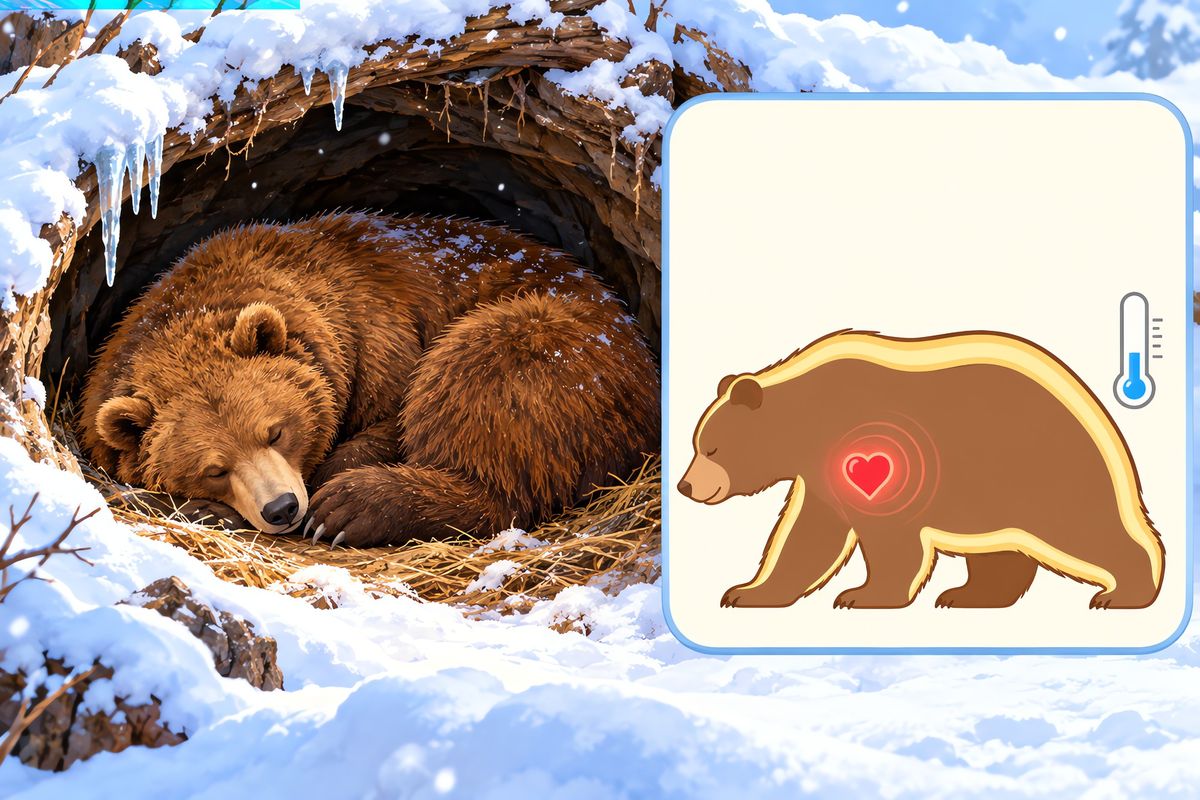
Bears eat berries, nuts, grass, insects, fish and just about anything else they can find. In winter, nearly all of that disappears under snow. Rather than starve, a bear does something clever: it shuts its body down to the lowest setting and waits for spring. Scientists call this hibernation.
Getting ready is the biggest part of the job. In late summer and fall, a bear may eat for 20 hours a day, packing on a thick layer of fat. That fat is its winter pantry.
How it works, in 3 steps
1. In fall, the bear eats and eats. This feeding frenzy has a name, hyperphagia. A black bear can gain several pounds a day, and by the time it dens up it may have doubled its fat.
2. As food runs out, it curls up in a den. The den might be a hollow tree, a cave, a dug-out hillside or a pile of brush. The bear lines it with leaves and grass and settles in, usually alone, except for a mother with her cubs.
3. Stored fat keeps it going until spring. Inside, a black bear’s heart slows from about 45 beats per minute to as low as 8. Its breathing slows too. Its body temperature drops only a little, which lets it wake up fast if something disturbs the den. Slowly, over months, it burns its fat for energy.
Here is the part that amazes scientists most. A hibernating bear doesn’t pee or poop for months. Instead, its body recycles the waste into protein, which protects its muscles from wasting away. People who lie in bed for months lose muscle; bears come out of the den thin but strong, having lost up to 30 percent of their weight, almost all of it fat. Quick fact: a newborn black bear cub, born in the den in midwinter, weighs about 1 pound or less.
Myth or fact?
“Hibernating bears wake up to go to the bathroom.” Myth. Bears don’t pee or poop for months. Their bodies recycle the waste into protein instead.
“A hibernating bear’s body turns ice cold.” Myth. A black bear’s temperature drops only about 12°F (7°C), from around 100°F to 88°F. Small hibernators like ground squirrels get much colder; bears stay fairly warm.
“Mother bears sleep through giving birth.” Myth. Mother bears are awake when their cubs are born in the den, and they nurse and care for them all winter while eating nothing themselves.
- Have your child find their pulse on the inside of their wrist (or hold a hand flat on their chest). Count the beats for 15 seconds and multiply by 4. Kids usually get 70 to 100.
- Now tap that rhythm on the table. Then tap a bear’s summer heart, about 45 a minute (a beat every 1.3 seconds). Then a hibernating bear: 8 a minute, one slow tap every 7 or 8 seconds.
- Count how many times they breathe in one minute, then imagine taking only one breath every 45 seconds, like a sleeping bear.
Feeling the gap between taps makes the number real. Eight beats a minute is slow enough that a bear’s whole body is running on the lowest setting there is.
Sources
Every fact in this article was checked against these sources, which are also listed at the back of the book:
National Park Service: Species spotlight, black bear
Yellowstone Forever: Naturalist notes on hibernation
100,000 Whys for Curious Kids
This question is one of 100 in 100,000 Whys for Curious Kids by Daniel Why. Full-color illustrated encyclopedia, ages 6–13, every answer checked against real sources. A labeled diagram, three steps and three myths busted for every big question. Launching on Amazon in October 2026.
See it on AmazonFree Myth or Fact printable packMore big questions: see all the questions kids ask. Have a little one at home? The toddler and preschool edition is coming this fall.