Why do cats’ eyes glow in the dark?
Two green-gold lights under the bushes at night. It looks a little spooky, but the explanation is a clever trick of mirrors.
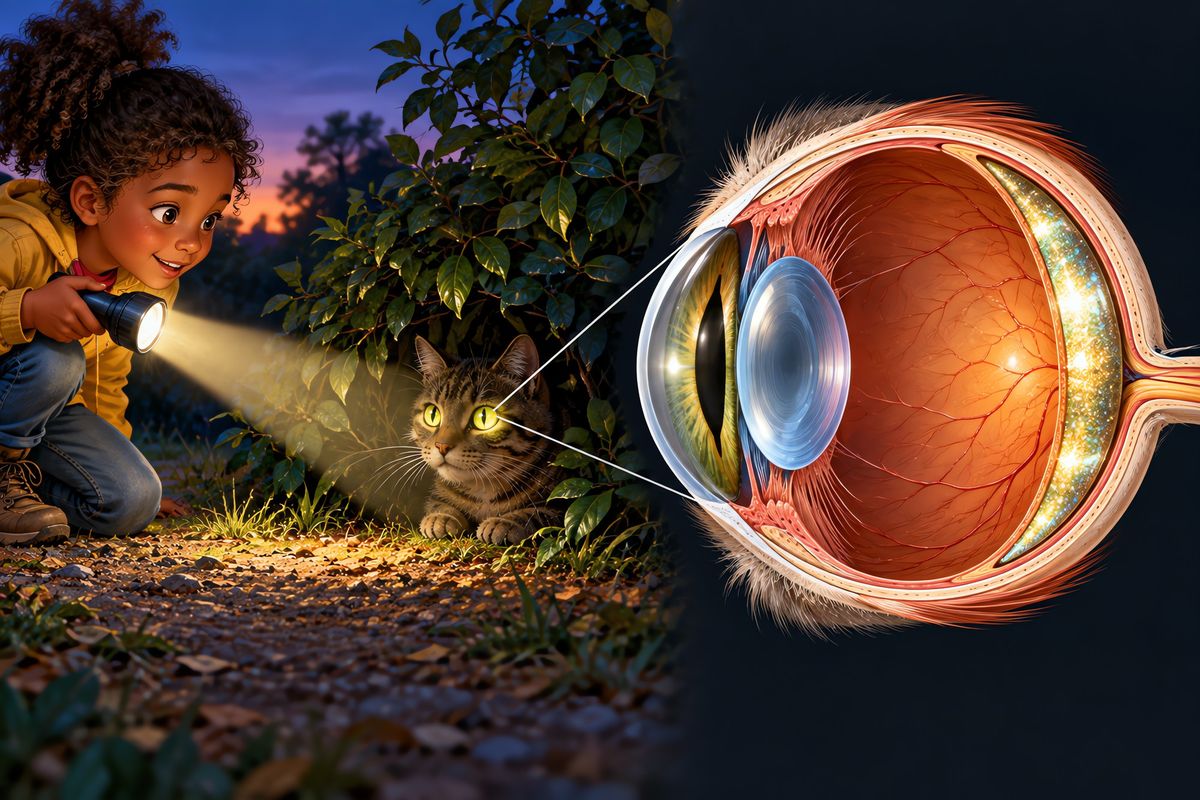
Look closely at a cat’s eye and you are looking at a tiny camera. Light comes in through the pupil, passes through the lens and lands on the retina, a thin layer at the back that senses light and sends signals to the brain. So far, our eyes work the same way.
The difference is what sits behind the retina. In a cat, there is a shiny layer called the tapetum lucidum (Latin for “bright carpet”). Any light that slips past the retina hits this mirror and bounces straight back through the retina, giving the eye a second chance to catch it. That is why cats see so well at dusk: they can see in light only about 16 percent as bright as people need.
How it works, in 3 steps
1. Light enters the cat’s eye. Even on a dark night there is a little light from the Moon, the stars or a porch lamp. It passes through the pupil, which opens very wide in the dark.
2. A shiny layer bounces the light back. Light that gets past the retina hits the tapetum lucidum and reflects back through the retina a second time. The cat’s eye gets two looks at the same faint light.
3. Some light escapes, so the eyes glow. Not all of the bounced light gets caught. Some leaves through the pupil, right back toward whatever sent it. If that was your flashlight, or a car’s headlights, you see two glowing eyes.
That is why you never see the glow in a completely dark room. There has to be a light source, and you have to be standing close to it, so the reflection comes back toward you. Move your flashlight to the side and the glow disappears. The color of the glow depends on the animal: cats often shine green or gold, dogs often green or blue, and some animals red.
Myth or fact?
“Cats’ eyes glow because they make light.” Myth. The glow is light bouncing off a shiny layer at the back of the eye. No light source, no glow.
“Cats can see in total darkness.” Myth. Cats need some light. Their eyes just use dim light much better than ours, thanks to the mirror layer and their wide pupils.
“Only cats have eyes that glow.” Myth. Dogs, deer, raccoons, cows, horses and many other animals that are active at night have a shiny eye layer too. People do not, which is why our eyes show up red in flash photos instead: the flash reflects off blood vessels at the back of the eye.
- At night, ask your child to hold a small flashlight right next to their own eye, pointing at the cat (or dog) from a few steps away. The eyes glow.
- Now hold the flashlight out at arm’s length, to the side, still pointing at the cat. The glow fades or vanishes.
- Never shine the light into the animal’s eyes for more than a second or two, and let the cat walk away if it wants.
The reflection comes back along the same line the light went in. If your eye is not on that line, you miss it. That is the same trick that makes road reflectors light up for your car and nobody else.
Sources
Every fact in this article was checked against these sources, which are also listed at the back of the book:
Carnegie Museum of Natural History: Why do cat eyes glow in the dark?
ABC Education: Why do cat eyes glow in the dark?
The Nature Conservancy: The science of eyeshine
100,000 Whys for Curious Kids
This question is one of 100 in 100,000 Whys for Curious Kids by Daniel Why. Full-color illustrated encyclopedia, ages 6–13, every answer checked against real sources. A labeled diagram, three steps and three myths busted for every big question. Launching on Amazon in October 2026.
See it on AmazonFree Myth or Fact printable packMore big questions: see all the questions kids ask. Have a little one at home? The toddler and preschool edition is coming this fall.