Why do I get brain freeze?
One big bite of a snow cone and suddenly your forehead hurts. Your brain is fine. Here is what is really going on.
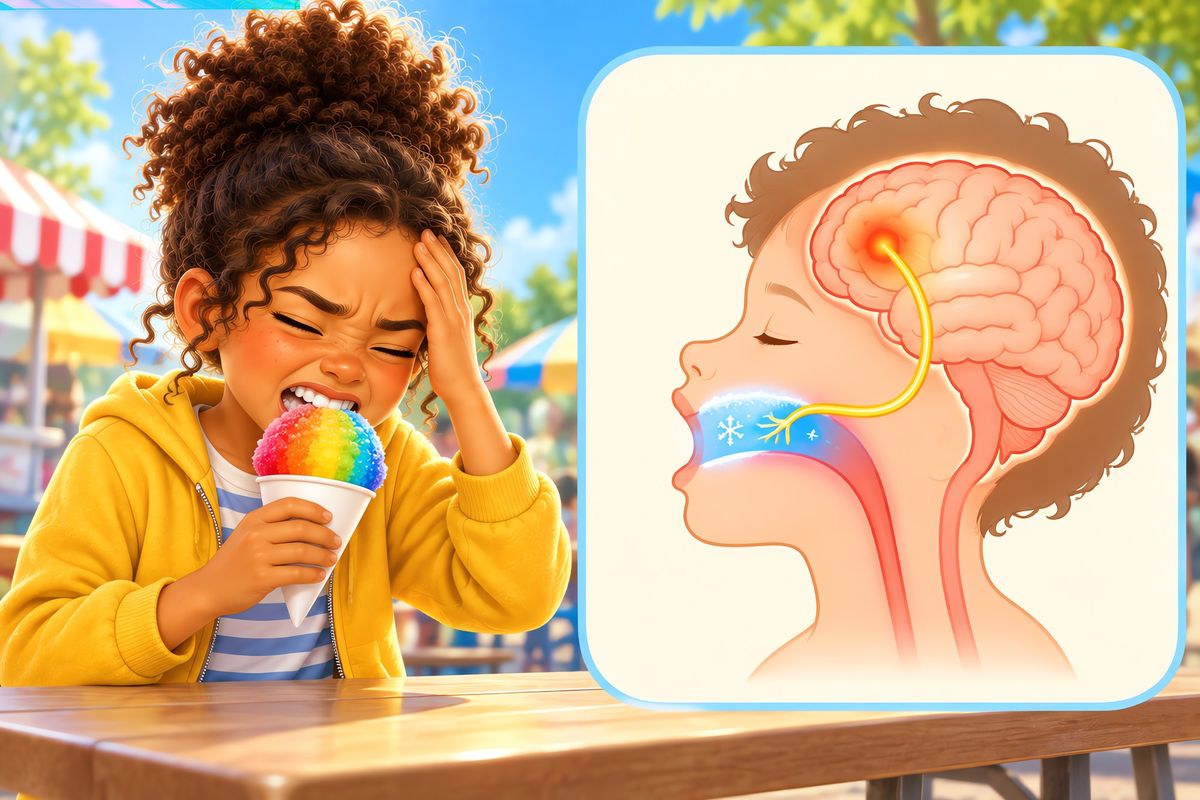
The medical name for brain freeze is a mouthful: sphenopalatine ganglioneuralgia. Doctors also call it an ice cream headache, and that is a better clue, because the whole thing starts in your mouth, not your head.
The roof of your mouth and the back of your throat are full of tiny blood vessels and nerve endings. They are used to warm food and warm air. A big gulp of something icy is a shock to them.
How it works, in 3 steps
1. Something icy chills the roof of your mouth. Ice cream, a slushie or a milkshake gulped fast drops the temperature of the roof of your mouth very quickly.
2. Blood vessels squeeze, then quickly widen. The small blood vessels tighten to protect against the cold, then rush open again to bring warm blood back. Pain sensors nearby notice this fast change and fire off a signal.
3. Your brain feels the pain in your forehead. The signal travels along the trigeminal nerve, a big nerve that carries feeling from your face, mouth and forehead. Because the same nerve serves all those places, your brain gets confused about where the signal started and you feel the ache in your forehead or temples. Doctors call this referred pain.
The good news: brain freeze is harmless and usually fades in well under five minutes, often in less than a minute. Quick fact: about 30 to 40 percent of people who rarely get any kind of headache still get brain freeze.
Myth or fact?
“During brain freeze, your brain actually freezes.” Myth. Your brain stays warm and safe inside your skull. Blood vessels and nerves in your mouth are reacting to the cold.
“Brain freeze is dangerous.” Myth. It is harmless and passes in less than five minutes. It is just a very convincing false alarm.
“Brain freeze pain starts in your forehead.” Myth. It starts in the roof of your mouth. Your brain just mixes up the address because the same nerve serves both places.
- Next time your child gets brain freeze, have them press their tongue flat against the roof of their mouth and hold it there.
- Count out loud together. Most people feel the ache fade within 20 to 30 seconds.
- For a slower experiment, eat the next scoop in small bites and let each one warm up on the tongue first. Does the freeze still come?
Warming the roof of the mouth calms the blood vessels, and the false alarm stops. Slow bites work because the cold never hits all at once.
Sources
Every fact in this article was checked against these sources, which are also listed at the back of the book:
Harvard Health: What causes ice cream headache?
Scientific American: Brain freeze explained
100,000 Whys for Curious Kids
This question is one of 100 in 100,000 Whys for Curious Kids by Daniel Why. Full-color illustrated encyclopedia, ages 6–13, every answer checked against real sources. A labeled diagram, three steps and three myths busted for every big question. Launching on Amazon in October 2026.
See it on AmazonFree Myth or Fact printable packMore big questions: see all the questions kids ask. Have a little one at home? The toddler and preschool edition is coming this fall.