Why do zebras have stripes?
Scientists have argued about this for more than a century. The answer with the best evidence today is a surprise: flies.
The ideas scientists tested
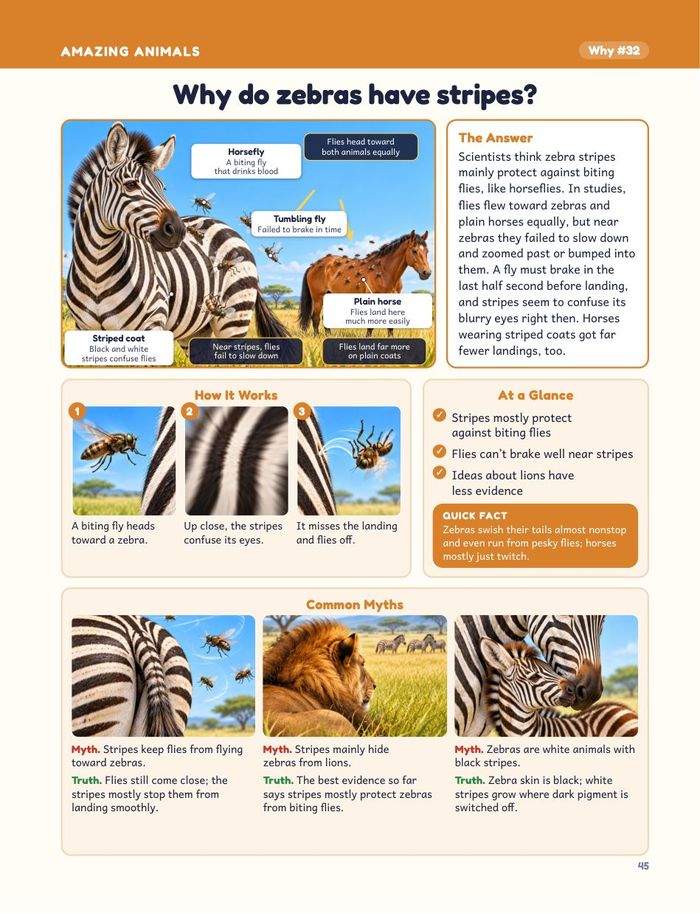
For a long time there were four big guesses: stripes help zebras hide from lions, keep them cool, help zebras recognize each other, or protect them from insects. Researchers tested each idea. The insect idea kept winning.
The experiment that cracked it
In 2019, scientists in England filmed horseflies around zebras and around plain-colored horses on the same farm. The flies flew toward both. But near zebras, they failed to slow down properly and mostly bounced off or flew past. Then the scientists put striped coats on the horses, and the flies had trouble landing on the horses too. The stripes seem to scramble how a fly judges speed and distance as it comes in to land.
Why does this matter so much to a zebra? In Africa, biting flies can spread serious diseases to horses and zebras. Fewer bites means a healthier zebra.
Myth or fact?
“Zebras are white with black stripes.” Myth, sort of. Under the fur, zebra skin is dark. Most scientists describe zebras as black with white stripes.
“No two zebras have the same stripes.” Fact. Every zebra’s pattern is unique, a bit like a fingerprint.
100 big questions like this one
This is one of 100 questions in 100,000 Whys for Curious Kids by Daniel Why: a full-color visual encyclopedia for ages 6 to 12, with a labeled diagram for every big question and 300 myths busted. It comes out on October 13, 2026.
Join the launch teamFree Myth or Fact cardsSources: Caro T. et al. (2019), “Benefits of zebra stripes: Behaviour of tabanid flies around zebras and horses,” PLOS ONE; Smithsonian’s National Zoo, “Grevy’s zebra.”