Why does the Moon change shape?
One night it is a thin sliver, two weeks later a big bright circle. Kids notice, and they want to know where the rest of the Moon went.
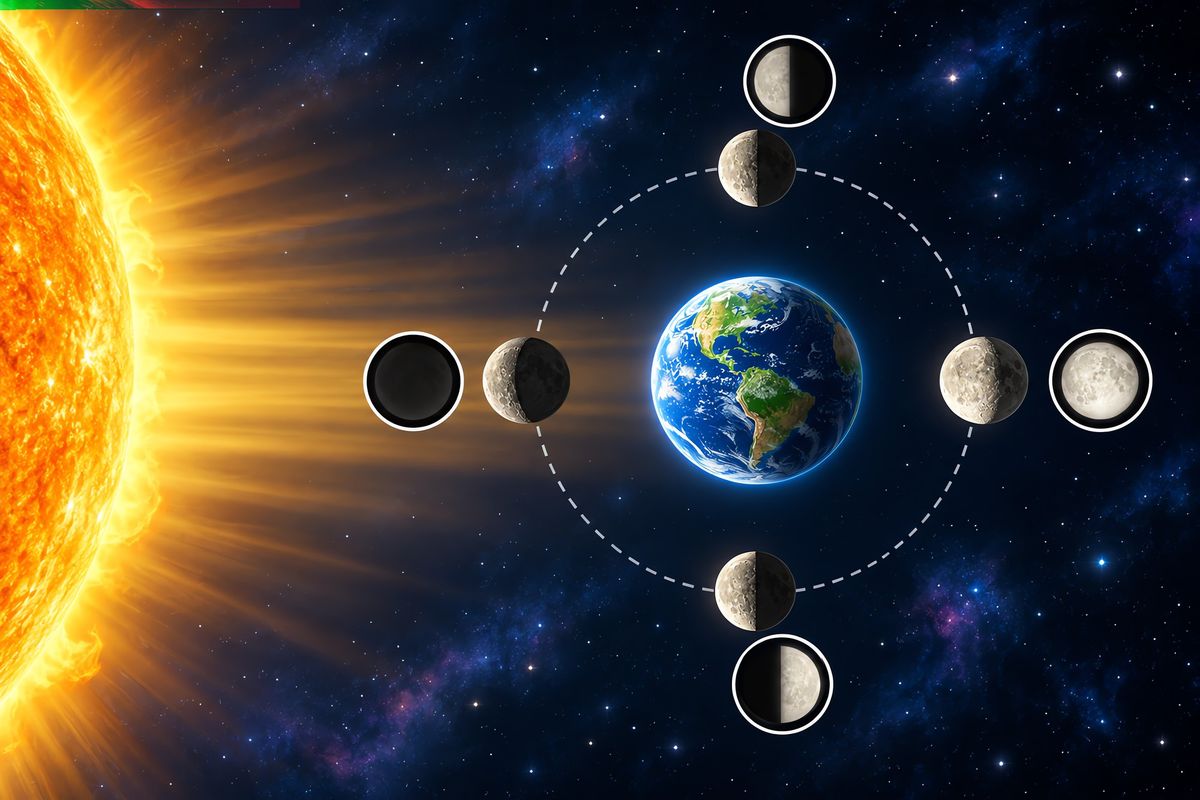
Here is the surprise at the heart of this question: the Moon makes no light of its own. It shines because sunlight bounces off its gray, rocky surface, the same way a white wall lights up when you point a flashlight at it. Take away the Sun, and the Moon would be a dark ball in a dark sky.
The Sun lights half of the Moon at all times, just as it lights half of Earth (that is the daytime side). What changes from night to night is not the Moon itself but where we are standing when we look at it.
How it works, in 3 steps
1. The Sun always lights half of the Moon. Picture a ball in a dark room with one lamp. One side is bright, the other is in shadow. The Moon is that ball, the Sun is that lamp, and the lit half always faces the Sun.
2. The Moon travels around Earth about once a month. The Moon circles Earth in about 27.3 days. As it moves, the lit half keeps facing the Sun, but from Earth we see it from a new angle every night.
3. We see more or less of the lit half. When the Moon sits between Earth and the Sun, the lit half faces away from us and we see almost nothing: a new moon. A week later we see half of the lit side: first quarter. When Earth is between the Sun and the Moon, we see the whole lit face: a full moon. Then it shrinks back again.
One full cycle of phases, from new moon to new moon, takes about 29.5 days. That is a little longer than one trip around Earth because Earth is also moving around the Sun, so the Moon has to travel a bit farther to line up the same way again. Quick fact for the dinner table: the Moon circles Earth in about 27.3 days, but the phases repeat every 29.5.
Myth or fact?
“Earth’s shadow makes the Moon’s phases.” Myth. The phases come from our view of the sunlit half. Earth’s shadow only lands on the Moon during a lunar eclipse, which is a different event and much rarer.
“The Moon has a dark side that never gets sunlight.” Myth. The far side of the Moon gets just as much sunlight as the side we see. We simply never see it from Earth, because the Moon always keeps the same face toward us.
“The Moon makes its own light.” Myth. Moonlight is sunlight bouncing off the Moon’s gray rock. The Moon is a mirror, not a lamp.
- Darken the room. One person holds a flashlight (the Sun) and stays still.
- Your child holds a ball (the Moon) at arm’s length and stands with their back to the flashlight. The ball looks fully lit: a full moon.
- Now they slowly turn in a circle, keeping the ball out in front. Watch the bright part shrink to a half, then a sliver, then disappear when the ball is between them and the light: a new moon.
The ball never changed. Only the view did. That is exactly what happens in the sky over one month.
Sources
Every fact in this article was checked against these sources, which are also listed at the back of the book:
NASA Science: Moon phases
NASA Space Place: The Moon’s phases
100,000 Whys for Curious Kids
This question is one of 100 in 100,000 Whys for Curious Kids by Daniel Why. Full-color illustrated encyclopedia, ages 6–13, every answer checked against real sources. A labeled diagram, three steps and three myths busted for every big question. Launching on Amazon in October 2026.
See it on AmazonFree Myth or Fact printable packMore big questions: see all the questions kids ask. Have a little one at home? The toddler and preschool edition is coming this fall.