Why does thunder come after lightning?
Flash first, then the wait, then the boom. The gap tells you something useful: how far away the storm is.
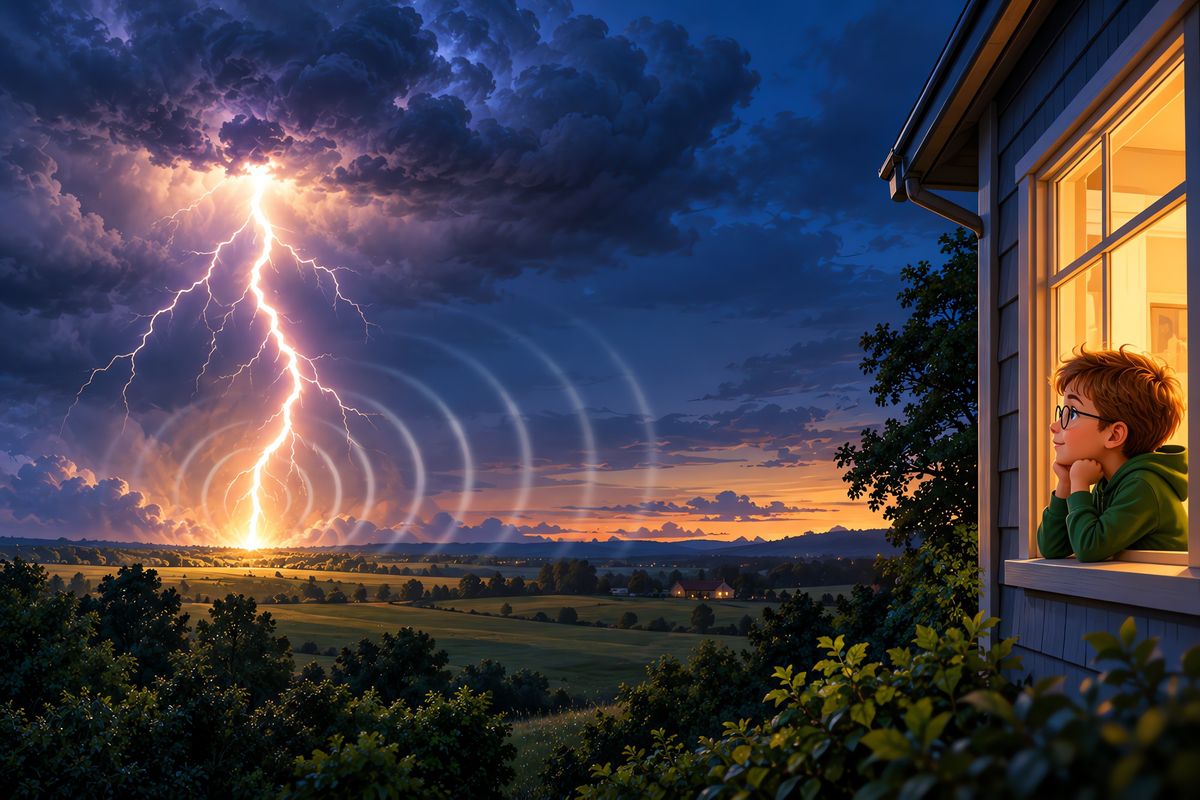
A lightning bolt is a giant electric spark, the same kind of spark you get from a doorknob on a dry day, only about a billion times bigger. In a split second it heats the air around it to as much as 50,000°F (27,700°C). That is about five times hotter than the surface of the Sun.
Air that hot expands explosively. It slams outward into the cooler air around it, making a shock wave that we hear as thunder. The crackle and rumble come from different parts of the long bolt, some closer to you and some farther away, and from the sound bouncing off hills and clouds.
How it works, in 3 steps
1. Lightning heats the air in a split second. The electric spark jumps from the cloud to the ground (or from cloud to cloud) and superheats a narrow channel of air along its path.
2. The hot air bursts outward with a boom. The superheated air expands faster than the speed of sound, creating a shock wave. That is the crack you hear when lightning is close, and the long rumble when it is far away.
3. Light arrives first; sound arrives seconds later. Light travels about 186,000 miles per second, so the flash is instant. Sound crawls along at about a mile every 5 seconds. Every second between flash and boom means the bolt was about a fifth of a mile away.
If you see the flash and hear the thunder at the same moment, the strike was very close. If you count 10 seconds, it was about 2 miles away. The important safety rule: if you can hear thunder at all, the storm is close enough to strike you, so head indoors and wait 30 minutes after the last rumble before going back out.
Myth or fact?
“Lightning never strikes the same place twice.” Myth. Tall objects get hit again and again. The Empire State Building averages about 23 strikes a year.
“Thunder is clouds bumping into each other.” Myth. Clouds are made of tiny water droplets and can’t bump. Thunder is the boom of air heated by lightning bursting outward.
“If it isn’t raining, lightning can’t hit you.” Myth. Lightning often strikes more than 3 miles from a storm’s center, well outside the rain. Blue sky overhead is not a guarantee of safety if you can hear thunder.
- The next time a storm is far away (and you are safely indoors), watch for a flash and start counting slowly: one-one-thousand, two-one-thousand …
- Stop when you hear the thunder. Divide your count by 5. That is roughly how many miles away the lightning was.
- Do it again a few minutes later. Is the number getting smaller? The storm is coming closer.
No storm today? Stand at opposite ends of a long field with a grown-up. Have them clap two blocks together while you watch. From far enough away you will see the clap before you hear it, for exactly the same reason.
Sources
Every fact in this article was checked against these sources, which are also listed at the back of the book:
National Weather Service: Understanding lightning and thunder
National Weather Service: Lightning myths and facts
100,000 Whys for Curious Kids
This question is one of 100 in 100,000 Whys for Curious Kids by Daniel Why. Full-color illustrated encyclopedia, ages 6–13, every answer checked against real sources. A labeled diagram, three steps and three myths busted for every big question. Launching on Amazon in October 2026.
See it on AmazonFree Myth or Fact printable packMore big questions: see all the questions kids ask. Have a little one at home? The toddler and preschool edition is coming this fall.