Why is the ocean blue?
Most grown-ups answer “because it reflects the sky.” That is only a small part of the story, and the real reason is more interesting.
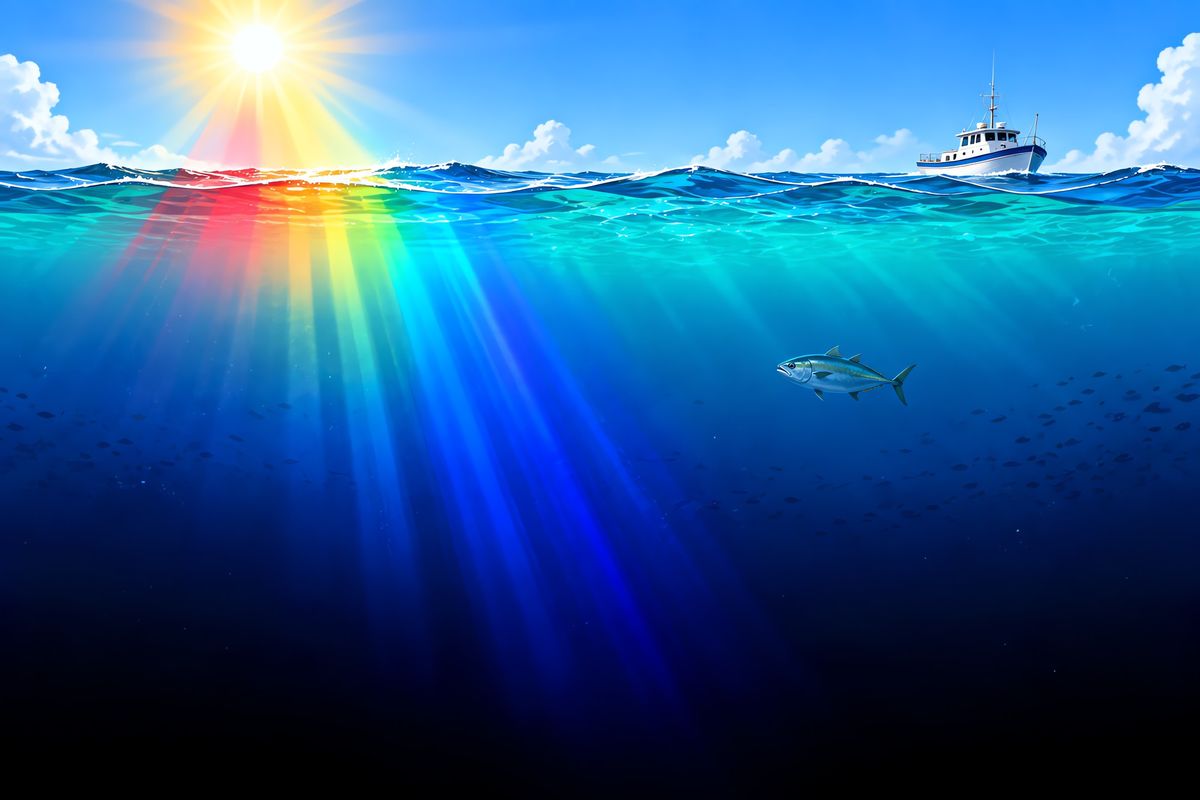
Sunlight looks white, but it is really a mix of every color: red, orange, yellow, green, blue and violet all traveling together. You can see them separated in a rainbow. When that mix enters the ocean, the water treats each color differently.
Water works like a filter. It absorbs the red end of the mix first, then orange and yellow. Blue light gets absorbed much more slowly, so it travels deeper and gets scattered around by the water. Some of that scattered blue light comes back up to the surface and into our eyes.
How it works, in 3 steps
1. Sunlight, a mix of colors, enters the water. Every color of the rainbow arrives at the surface together.
2. Water soaks up red and orange light. In the first few dozen feet, the red and orange light is absorbed by the water molecules and turns into a tiny bit of heat. That is why underwater photos taken deep down look blue-green even when the fish are red.
3. Leftover blue light bounces back to our eyes. Blue light survives longest. Some of it scatters back toward the surface, and that is the color we see when we look at the sea.
This only works when light passes through a lot of water. A bathtub or a drinking glass is too thin to filter much, so it looks clear. It takes a whole ocean to show the blue. Go deep enough and the blue runs out too: in clear ocean water, light gets about 10 times dimmer every 246 feet (75 meters) down, and below about 3,280 feet (1,000 meters), no sunlight reaches at all. Most of the deep sea is completely dark.
Myth or fact?
“The ocean is blue only because it reflects the sky.” Myth. The sky adds a little on a bright day, but the water itself absorbs red light and leaves blue to scatter back. The sea still looks blue on a gray day if the water is deep and clear.
“A glass of seawater should look blue.” Myth. A glass is far too thin to filter much light. You need a lot of water for the blue to show.
“The ocean is the same blue everywhere.” Myth. Floating sediments, plankton and particles can tint the water green, brown or even reddish. Coastal water near rivers often looks green; clear tropical water looks bright blue.
- Fill a clear glass with tap water and hold it up to a window. It looks clear.
- Now fill a white bathtub or a large white bowl as deep as you can and look straight down into it in good light. The water looks very faintly blue.
- Ask: what would it look like if the water were as deep as a house? As deep as a mountain?
Same water, same light. The only difference is how much water the light has to travel through, and that is the whole secret of the blue sea.
Sources
Every fact in this article was checked against these sources, which are also listed at the back of the book:
NOAA National Ocean Service: Why is the ocean blue?
NOAA Ocean Exploration: Light in the deep sea
100,000 Whys for Curious Kids
This question is one of 100 in 100,000 Whys for Curious Kids by Daniel Why. Full-color illustrated encyclopedia, ages 6–13, every answer checked against real sources. A labeled diagram, three steps and three myths busted for every big question. Launching on Amazon in October 2026.
See it on AmazonFree Myth or Fact printable packMore big questions: see all the questions kids ask. Have a little one at home? The toddler and preschool edition is coming this fall.